Abstract:
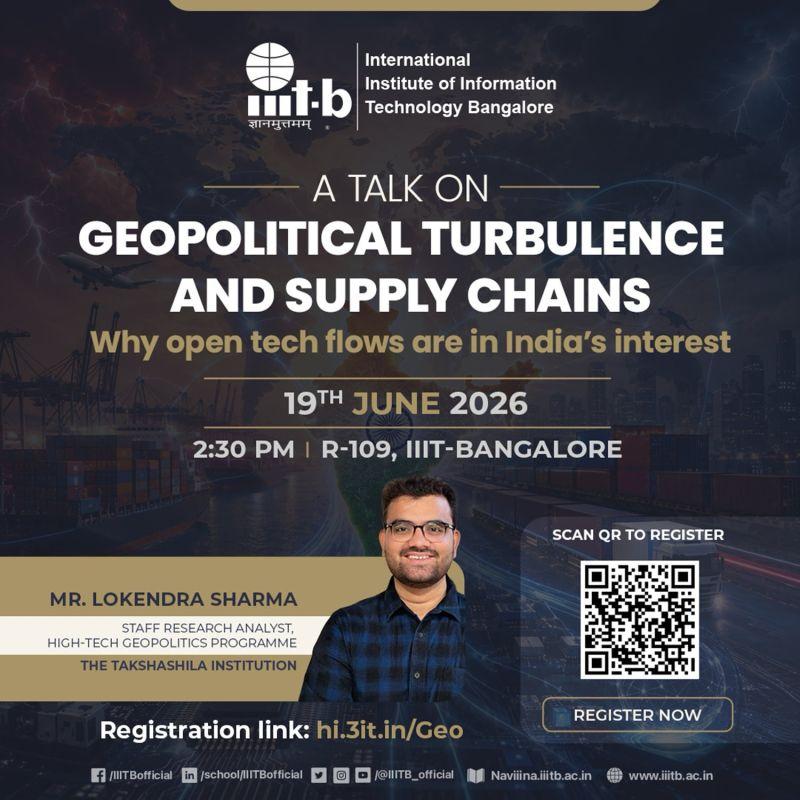
From AI and semiconductors to critical minerals, the US-China tech rivalry has undergone periods of intensification and diminution over the last few years. During its peak moments, the US and China have engaged in supply chain warfare to constrain the flows of technology and material in order to attain technological dominance. But the impact of constrained flow of tech and material has not been limited to the contesting major powers; developing countries like India are caught in the cross-fire. For example, when former US president Biden’s administration divided the world into three tiers for AI diffusion in January 2025, India and most of the developing world were placed in tier 2. This meant India had to contend with ad-hoc procurement and other hurdles for securing AI chips and models. Not to be left behind, China borrowed a leaf out of the US playbook and flipped the supply chain warfare script by placing export controls on rare earths that affected the entire developing world, including India. While at present the US-China tech rivalry seems to be going through a period of diminution owing to the peculiarities of Trump’s engagement with Beijing, the structural nature of US-China competition means that intense rivalry may revive in the future.
India’s challenges are further compounded by supply chain security concerns. For decades, supply chains were defined by efficiency (just in time). The pandemic brought forth the discourse of resilience (just in case). But two developments — Israel’s supply chain attack in Lebanon and the US banning connected car technologies linked with China — in the last few years are shifting supply chains towards security (just to be secure). Inspecting the supply chains of technology products has placed additional strains on the limited capacities of developing countries, including India.
How should India respond to the dual challenges of supply chain warfare and security in geopolitically turbulent times?
The answer lies in striking at proprietary technologies, that is, the core of what enables both challenges. A major power can only weaponise what it owns and controls. Open technologies, on the other hand, are hard to limit to any particular geography. Further, open technologies are also comparatively easier to scrutinise for any security concerns.
In this talk, I would discuss the aforementioned geopolitical turbulence in greater detail, examine where India’s interests lie, and finally propose that India should spearhead the creation of an Open Technology Maitri, a multistakeholder initiative for promoting the uptake and deployment of open technologies.