Author: Gana K
Superset district profile Template
factor profile ui state selection testing
Superset
Education
Secondary School Dropouts
Data-driven analysis of factors influencing secondary school dropout outcomes
Agriculture
Agriculture Price Fluctuations
Data-driven analysis of factors influencing agricultural price fluctuations
Use Cases
Secondary School Dropouts(superset)
Secondary School Dropout
Secondary school dropout remains a critical challenge, impacting long-term educational attainment, workforce readiness, and socio-economic development. To address this issue proactively, this use case leverages data-driven modeling techniques to identify patterns, risk factors, and vulnerable student segments associated with dropout at the secondary education level.
Modeling Approaches Used
1. Sensitivity Modeling
The Sensitivity Modeling dashboard is designed as a tool to analyze and reduce school dropout rates across India by identifying high-impact factors at the state and district levels. It enables us to explore dropout trends, understand how different factors influence the dropout rate, and perform what-if scenario analysis for data-driven decision making.
2. Prescriptive Modeling
Prescriptive modeling answers one key question: “What changes are needed to reach a target dropout rate?” The model recommended changes for each factor are called prescribed values. Prescriptive modeling considers all factors together and finds a combination that best supports achieving the target.
We have employed both modeling approaches and developed a sequence of dashboards tailored for two distinct user groups: district-level and state-level officials.
For access to the detailed user manual, click here.
1(a). District View (District Profile)
Under the District View, users can drill down from the All India Dashboard to a district-wise dropout map and access detailed district profile, results in a District Prescription module. This section supports both what-if analysis and what-to-do analysis, enabling users to simulate changes across key factors and assess their relative impact on reducing secondary school dropout rates. The what-if analysis helps identify which factors contribute most significantly to lowering dropout rates within a district, while the what-to-do analysis translates these insights into actionable, data-driven recommendations to guide targeted interventions and policy decisions.
1(b). District Prescriptive

2(a). State View (Factor Profile)
Under the State View, users navigate from the All India Dashboard to a district-wise dropout map, followed by a Factor Profile that enables what-if analysis to assess which factors contribute most significantly to reducing dropout rates across districts within a state. This is complemented by the Intervention Index, which supports what-to-do analysis by quantifying how much each factor needs to change to achieve a targeted reduction in secondary school dropout at the state level. These insights feed into the State Prescription and State Budget modules, helping policymakers prioritize interventions, allocate resources efficiently, and design evidence-based strategies tailored to state-specific needs.

2(b). All India Intervention Index, State Prescriptive and State Budget
The Intervention Index shows how much support or action a state needs, based on the model’s suggestions. Darker colors mean the state needs more intervention, while lighter colors mean less intervention is required. This makes it easy to quickly spot which states need the most attention.

Geopolitical turbulence and supply chains: Why open tech flows are in India’s interest

Abstract:
From AI and semiconductors to critical minerals, the US-China tech rivalry has undergone periods of intensification and diminution over the last few years. During its peak moments, the US and China have engaged in supply chain warfare to constrain the flows of technology and material in order to attain technological dominance. But the impact of constrained flow of tech and material has not been limited to the contesting major powers; developing countries like India are caught in the cross-fire. For example, when former US president Biden’s administration divided the world into three tiers for AI diffusion in January 2025, India and most of the developing world were placed in tier 2. This meant India had to contend with ad-hoc procurement and other hurdles for securing AI chips and models. Not to be left behind, China borrowed a leaf out of the US playbook and flipped the supply chain warfare script by placing export controls on rare earths that affected the entire developing world, including India. While at present the US-China tech rivalry seems to be going through a period of diminution owing to the peculiarities of Trump’s engagement with Beijing, the structural nature of US-China competition means that intense rivalry may revive in the future.
India’s challenges are further compounded by supply chain security concerns. For decades, supply chains were defined by efficiency (just in time). The pandemic brought forth the discourse of resilience (just in case). But two developments — Israel’s supply chain attack in Lebanon and the US banning connected car technologies linked with China — in the last few years are shifting supply chains towards security (just to be secure). Inspecting the supply chains of technology products has placed additional strains on the limited capacities of developing countries, including India.
How should India respond to the dual challenges of supply chain warfare and security in geopolitically turbulent times?
The answer lies in striking at proprietary technologies, that is, the core of what enables both challenges. A major power can only weaponise what it owns and controls. Open technologies, on the other hand, are hard to limit to any particular geography. Further, open technologies are also comparatively easier to scrutinise for any security concerns.
In this talk, I would discuss the aforementioned geopolitical turbulence in greater detail, examine where India’s interests lie, and finally propose that India should spearhead the creation of an Open Technology Maitri, a multistakeholder initiative for promoting the uptake and deployment of open technologies.
Inauguration of IIITB as Lead Knowledge Institution under NITI Aayog’s State Support Mission
Overview:
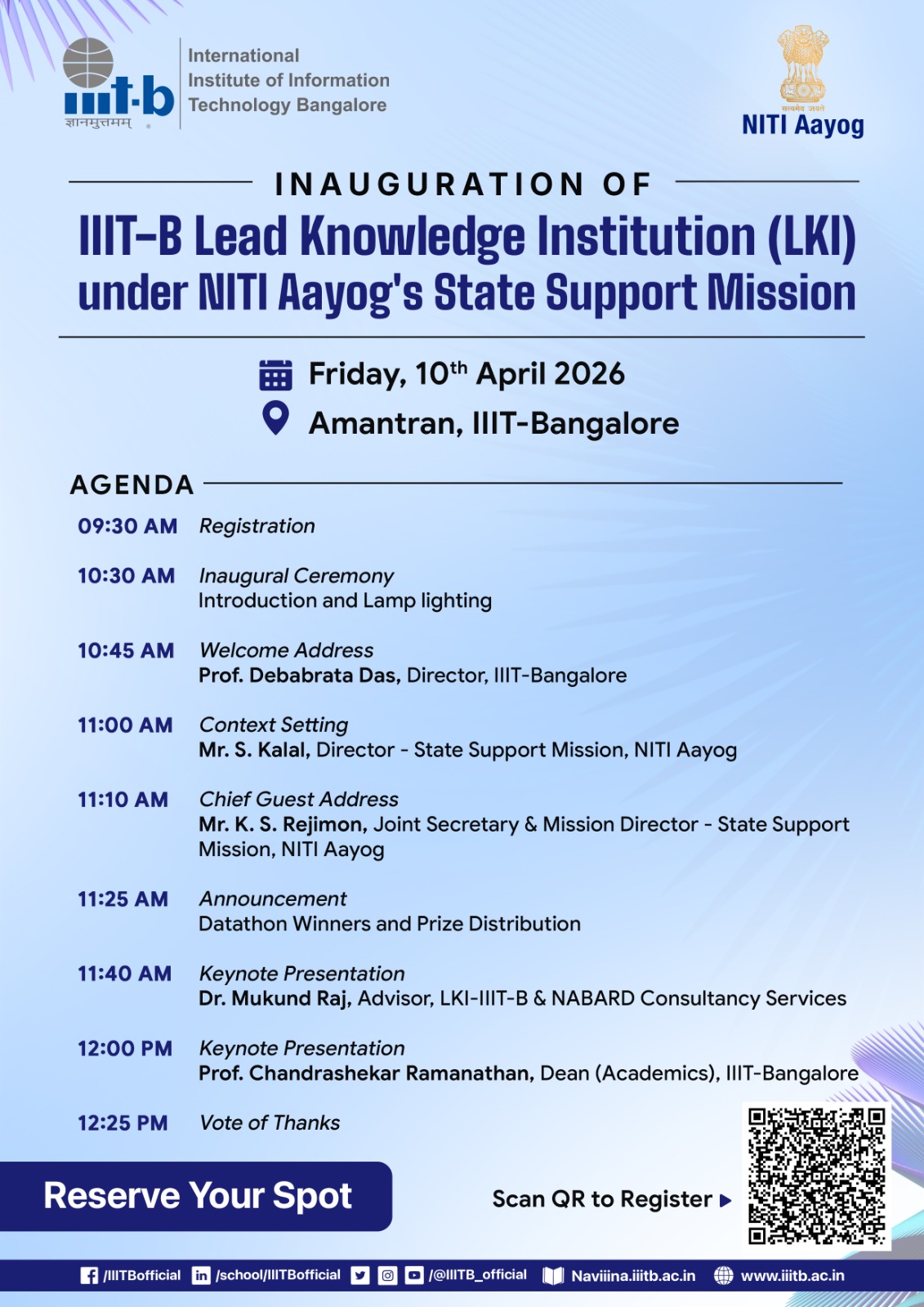
We are proud to announce the formal inauguration of the International Institute of Information Technology Bangalore (IIIT-B) as a Lead Knowledge Institution (LKI). This prestigious designation is part of NITI Aayog’s State Support Mission (SSM), an initiative designed to strengthen the strategic and technical capabilities of Indian states.
As an LKI, IIIT-B will play a pivotal role in providing data-driven decision support, academic excellence, and policy advisory to help states achieve transformative development goals.
Key Dignitaries & Speakers:
Prof. Debabrata Das (Director, IIIT-B): The executive head of the institute, leading the academic and research vision.
Mr. S. Kalal (Director, State Support Mission, NITI Aayog): A key figure from India’s premier policy think tank (NITI Aayog) who oversees the nationwide mission to support state governments.
Mr. K. S. Rejimon (Joint Secretary & Mission Director, NITI Aayog): Representing the Government of India, he provides the administrative and strategic framework for the State Support Mission.
Dr. Mukund Raj: An expert advisor bridging the gap between LKI-IIIT-B and NABARD (National Bank for Agriculture and Rural Development) Consultancy Services.
Prof. Chandrashekar Ramanathan (Dean Academics, IIIT-B): Leading the academic integration of this research into state level policy.
Event Schedule:
Date: Friday, 10th April 2026
Venue: Amanthran, IIIT-Bangalore
Timing: 10:00 AM – 12:30 PM